
You’ve invested in a pay-per-click (PPC) campaign, hoping to attract new patients to your urgent care clinic, specialty clinic, or hospital. You see the clicks coming in, but you aren’t getting any more scheduled appointments than usual. This is a common frustration for many in the healthcare field. Effective PPC advertising for urgent care, specialty clinics, hospitals, and other providers requires more than just launching a few ads; it demands a precise, data-driven strategy to connect with patients at the exact moment they need care. If your campaign isn’t delivering the new patients you expected, small, overlooked details are likely draining your budget and limiting your returns. When it comes to Google Ads or Microsoft Ads (formerly Bing Ads) — the devil is in the details.
Gatorworks is here to guide you through the common reasons why your healthcare pay-per-click campaign isn’t converting and provide clear, actionable steps to address them. We will explore how to refine your targeting, analyze what potential patients are actually searching for, and ensure your website provides a seamless path from click to conversion. By focusing on these key areas, you can transform your underperforming campaign into a reliable source of patient acquisition for your clinic.
What is Holding Your Healthcare PPC Advertising Back?
When a PPC campaign falls short, the issue often lies in one of three areas: attracting the wrong audience, a disconnect between the ad and the user’s intent, or a poor user experience after the click.
But for healthcare providers, there’s an added challenge — HIPAA privacy regulations. These rules make it tough to track conversions and figure out what’s working (or not), which can make diagnosing issues and determining ROI feel like solving a puzzle with missing pieces.
Let’s examine how to identify and resolve these problems.

1. Stop Wasting Money, Implement More Negative Keywords
One of the most powerful tools in your Google Ads or Bing Ads toolkit is the negative keyword list. Negative keywords are terms you add to your campaign to prevent your ads from showing for irrelevant searches. Without a robust negative keyword list, you will waste a significant portion of your ad spend on clicks from people who are not looking for your services.
For example, a person searching for “urgent care billing courses” is not a potential patient. Someone looking up “DIY remedies for a cough” is also not ready to book an appointment. By adding terms like “courses,” “jobs,” “training,” and “DIY” to your negative keyword list, you ensure that your budget is reserved for users with high commercial intent: those actively seeking medical care.
It’s important to note that on certain accounts, as little as 15-20% of search terms will be shown to you. So, this is not a full accounting of what led to every click. Instead, it is a good way to get a feel for what people are searching for that leads to your ads being shown. Being aggressive around search term analysis means that you can prevent higher funnel searches, research-oriented searches, and non-converting searches.
Here’s an example of what a negative keyword list might look like in a Google Ads account:
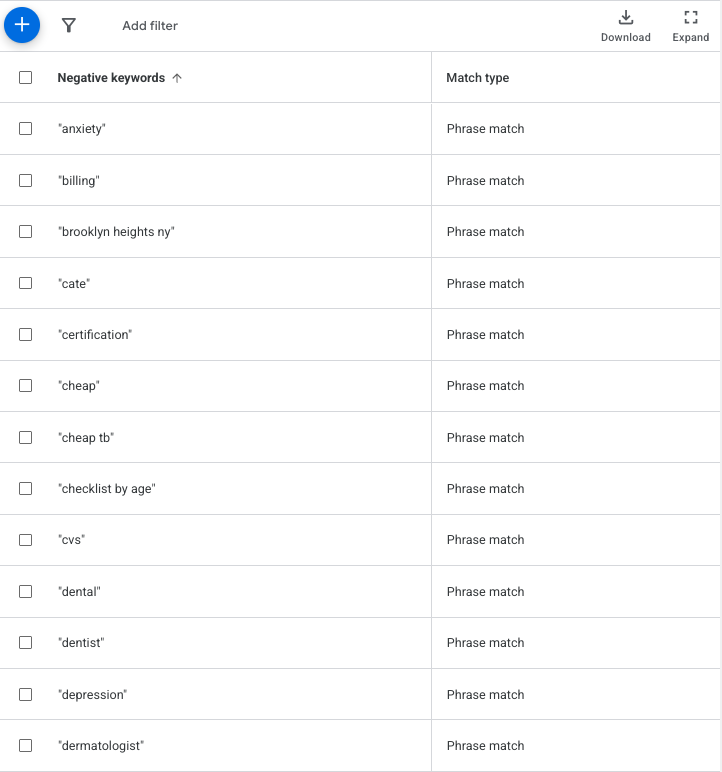
Regularly updating this list is crucial. As you review your campaign’s performance, you will discover new, irrelevant search terms that need to be excluded. This simple but continuous process sharpens your targeting and dramatically improves the quality of your leads.
2. Find Out What Patients Are Really Searching For
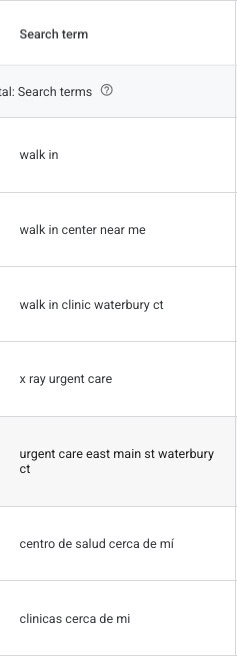
To refine your healthcare PPC advertising strategy, you must look beyond the keywords you are bidding on and analyze the actual search terms that trigger your ads. Search terms are the exact phrases people type into Google. This data provides invaluable insight into what your potential patients are thinking and what they need.
You can find this information in your Google Ads account under the “Search Terms” report. As you review this report, you might notice trends. For instance, you may find that many people are searching for a specific service you offer, like “weekend pediatrician near me,” but your ads direct them to a generic homepage. This is a missed opportunity.
By analyzing search terms, you can:
- Discover new keywords: Identify relevant, high-intent phrases you hadn’t considered.
- Refine your ad copy: Tailor your ad messaging to directly address the phrases people are using.
- Identify more negative keywords: Uncover irrelevant searches that are wasting your budget.
This process ensures your ads are not just visible but are highly relevant to the searcher’s needs. Whether you are running PPC ads for urgent care clinics or managing broader campaigns like PPC ads for hospitals, reviewing search terms is fundamental to improving performance and increasing conversions.

3. Optimize Your Landing Pages for Patients
Your landing page is where conversions happen. Even the best ad campaign will fail if it sends users to a confusing, slow, or unhelpful landing page. For healthcare providers, the landing page must build trust and make it incredibly easy for a potential patient to take the next step.
When reviewing your landing pages, consider the following:
- Relevance and Clarity: Does the page directly relate to the ad the user clicked? If your ad promotes “flu shots available now,” the landing page should prominently feature information about getting a flu shot, including hours and a clear call to action. Do not send them to your homepage and make them search for the information.
- Clear Calls to Action (CTAs): What do you want the user to do? Whether it’s “Book an Appointment,” “Call Now,” or “Check-In Online,” the CTA should be highly visible and easy to use. Make sure your phone number is clickable on mobile devices.
- Mobile-First Design: A majority of health-related searches happen on mobile devices, often in moments of stress. Your website must load quickly and be easy to navigate on a smartphone. Complicated forms or tiny buttons will cause users to abandon the page.
- Trust Signals: Include elements that build credibility. Display patient testimonials, list the insurance plans you accept, and showcase any certifications or awards. A professional, modern design reinforces that you are a trustworthy medical provider.
Think of your landing page as your digital front desk. It should be welcoming, efficient, and designed to help visitors find what they need without any friction. A well-optimized landing page is a critical component of successful healthcare PPC advertising.

Taking the Next Step With Your PPC Campaign
Optimizing a healthcare PPC advertising campaign is an ongoing process of refinement. By consistently adding negative keywords, analyzing search terms, and improving your landing pages, you can significantly increase your conversion rate and ensure your marketing dollars are generating a steady stream of new patients.
These strategies require time, expertise, and a deep understanding of how digital platforms work. If you are struggling to get the results you need, it may be time to partner with an agency that specializes in digital marketing for healthcare. At Gatorworks, we have a proven track record of helping urgent care clinics and other medical providers turn their PPC campaigns into powerful patient acquisition tools.
Get the Results Your Clinic Deserves
Stop wasting money on ineffective strategies and start seeing real growth for your clinic. At Gatorworks, our team of experts is ready to create a custom PPC strategy tailored to your needs. Let us help you attract the right patients and take your clinic to the next level.